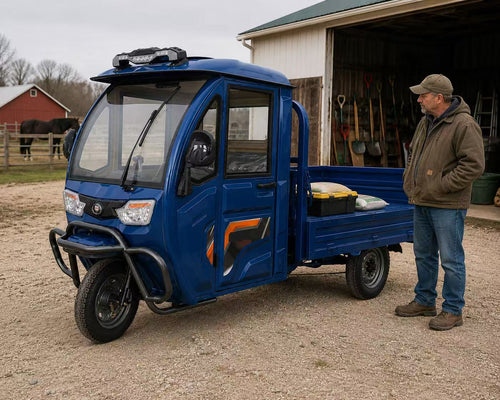
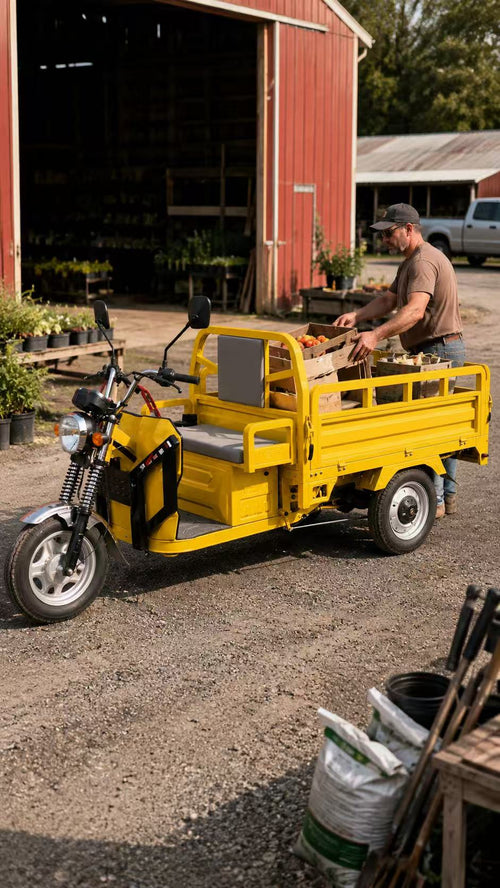
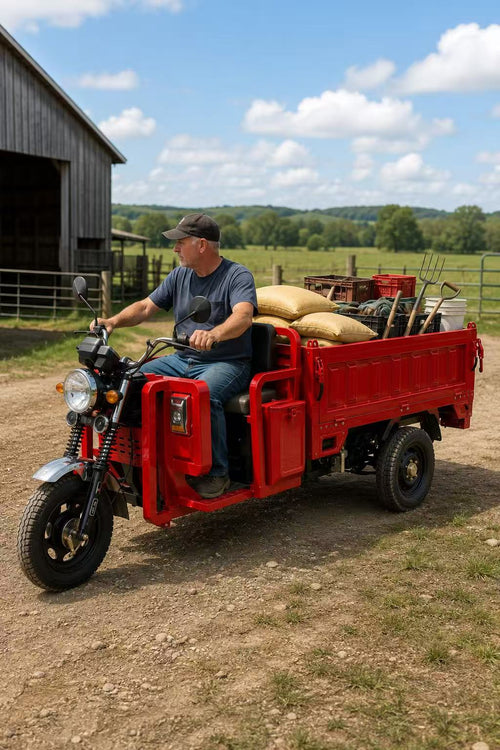
Dairy Farm Utility Vehicle Buyer Guide: Choose for Barn Workflow, Not Just Payload
Choosing a utility vehicle for a dairy farm or cattle operation is not simply a matter of comparing payload, speed, or cargo-bed size. A vehicle can look perfectly capable on a specification sheet and still become frustrating in daily barn work.
The better question is: Can the vehicle follow the actual route your workers follow every day?
On a dairy farm, that route may run from feed storage to a feed alley, through a narrow cross alley, past the milking area, into calf housing, through bedding and maintenance zones, and eventually toward washdown and charging. Each part of that route creates different requirements for vehicle width, turning space, cleanability, corrosion resistance, ground clearance, cargo access, and traction.
That is why a dairy farm utility vehicle should be selected around the farm's workflow first and its specifications second.
What Does the Vehicle Actually Need to Do Every Day?
Before comparing vehicles, map the jobs and locations where the vehicle will actually operate.
A typical dairy operation may require short, repetitive trips carrying feed supplements, milk-house supplies, bedding, tools, buckets, veterinary supplies, replacement hardware, or cleaning equipment. A cattle ranch may add longer trips between barns, pens, fence lines, water points, pasture areas, and maintenance locations.
These are very different operating conditions.
Inside a barn, compact dimensions and maneuverability may matter most. Outside, mud, gravel, ruts, uneven pasture lanes, and ground clearance become more important. A vehicle that performs well on one part of the farm may be poorly suited to another.
Instead of asking only, "How much can it carry?" ask:
Where will it travel?
What is the narrowest opening on that route?
Where must it make a 90-degree turn?
What surfaces will it cross?
How often will workers load and unload it?
Will it enter manure-contaminated areas and then return to cleaner livestock or feed areas?
How will it be washed, parked, and charged?
Those questions expose purchasing problems that payload specifications cannot.
Measure the Barn Before Choosing the Vehicle
One of the most expensive mistakes is buying the vehicle first and measuring the barn afterward.
Older tie-stall barns, calf facilities, milk-house corridors, gates, structural posts, and utility passages can create surprisingly tight clearances. Even in a larger free-stall barn, the limiting dimension may not be the main feed alley. It may be a doorway, cross alley, gate opening, or the space required to turn at the end of a route.
Vehicle width alone is therefore not enough.
Buyers should consider the complete turning envelope: vehicle width, overall length, wheelbase, steering geometry, and the actual space needed to complete a 90-degree turn without repeated backing and repositioning.
Feed alleys create another practical problem. Cows using headlocks can reduce usable clearance along the driving path. A vehicle that technically fits an empty alley may feel much larger during normal feeding activity.
For a barn transport vehicle, the narrowest and most difficult point in the daily route should help determine the maximum practical vehicle size.
Free-Stall, Tie-Stall, Calf and Ranch Operations Need Different Things
"Dairy farm" is too broad to describe one operating environment.
A free-stall dairy often combines wet or grooved concrete, manure slurry, bedding material, cross alleys, feed lanes, and frequent stop-start movement. If sand bedding is used, spilled sand can become an abrasive contaminant around bearings, brakes, steering components, and other exposed moving parts.
A tie-stall operation may create a different problem: absolute physical width. Older buildings can have narrow passages, gutters, posts, gates, and low utility lines. A large recreational-style UTV may have more capability than the farm needs but still be unable to reach the places where work actually occurs.
Calf operations create another set of priorities. Calf feeding carts, milk taxis, calf trolleys, and other specialized equipment exist partly because calf work involves repeated stops, narrow routes, frequent loading and unloading, and strict sanitation requirements. When a general-purpose electric farm vehicle is used for these chores, bed access and cleanability can matter as much as carrying capacity.
A cattle ranch shifts the decision again. Longer distances, pasture lanes, rocks, mud, washouts, fence-line work, and uneven ground place greater emphasis on ground clearance, stability, traction, and underbody protection.
The correct vehicle is therefore not simply the "best farm UTV." It is the vehicle whose geometry and construction match the operating environment.
The Clean-to-Dirty Workflow Is a Vehicle Decision
Dairy transportation is also a biosecurity issue.
A utility vehicle can become a mechanical carrier between different farm zones. Tires and the undercarriage that pass through manure-contaminated lanes should not automatically be treated as clean when the same vehicle later enters calf housing, maternity areas, feed handling zones, or other sensitive locations.
This matters particularly around young calves, where disease-control procedures are more stringent.
Before buying one vehicle to "do everything," map the clean-to-dirty direction of the farm.
For some operations, dedicated vehicles or carts for cleaner areas may be more practical than repeatedly moving one machine across every zone. Where one vehicle must cross zones, the farm needs a realistic cleaning and sanitation procedure that employees can actually follow during a busy shift.
This is an important distinction between general farm hauling and dairy barn transport: the shortest driving route is not always the correct operational route.
Washability Matters, but "Waterproof" Is Not a Specification
Barn vehicles accumulate manure, feed residue, bedding dust, mud, and organic material. Cleaning is therefore part of the duty cycle, not an occasional cosmetic task.
Buyers should examine how easily the cargo bed, wheel areas, frame, and underbody can be accessed for cleaning. Hidden pockets that retain manure or wet feed can increase cleaning time and accelerate deterioration.
Electrical protection also needs careful verification.
Terms such as "weather-resistant" or "waterproof" are too vague for a purchasing decision. Ask the supplier for the actual ingress-protection specifications of the battery enclosure, controller, connectors, charging components, and displays.
Do not assume that an electric utility vehicle can be directly pressure-washed simply because it can operate outdoors. Pressure-wash compatibility should be confirmed from the manufacturer's specifications and cleaning instructions.
A vehicle that takes too long to clean creates its own labor problem. If proper cleaning becomes inconvenient, it is more likely to be postponed during busy periods.
Corrosion Starts Below the Cargo Bed
Dairy barns are difficult environments for metal and electrical systems.
Manure slurry, moisture, silage leachate, wash chemicals, and airborne contaminants can repeatedly contact the vehicle. The purchasing decision should therefore go beyond exterior paint.
Inspect the frame coating, exposed fasteners, electrical connectors, wiring routes, battery terminals, charging port, weld areas, hinges, tailgate hardware, and other locations where moisture and contamination can remain trapped.
Silage areas deserve particular attention because acidic leachate can create a much harsher corrosion environment than ordinary rainwater.
Air quality matters as well. A vehicle parked or charged for long periods inside humid livestock housing is exposed differently from one stored in a separate, dry equipment area.
For a dairy operation, corrosion resistance is not merely an appearance issue. It affects how easily the vehicle can be maintained over years of repetitive barn use.
Sand, Lime, Bedding and Manure Change the Mechanical Environment
The barn floor may look simple, but the material on that floor changes how a vehicle works.
Wet grooved concrete requires predictable traction. Manure slurry creates a different surface. Deep bedding, gravel, and outdoor mud change rolling resistance again.
Sand-bedded dairies deserve special consideration. Sand mixed with moisture and manure can become highly abrasive around exposed mechanical components. Buyers operating in these barns should ask how wheel bearings, brakes, steering joints, seals, and other wear points are protected and serviced.
Fine bedding material and lime also create dust. Instead of assuming that ordinary body panels protect electrical components, inspect where dust can enter or accumulate and how those areas are cleaned.
The point is not to find a vehicle that is universally "farm tough." The goal is to identify what the vehicle will repeatedly contact on your specific farm.
Cargo-Bed Access Can Matter More Than Maximum Capacity
A large cargo bed is not automatically an ergonomic cargo bed.
Consider calf feeding, veterinary work, maintenance, and repeated handling of buckets or bags. If employees must repeatedly lift items over high fixed sides, every stop adds unnecessary motion and strain.
For frequent side-loading work, loading height and side access deserve attention. Fold-down or removable sides can also make it easier to load bedding, tools, gates, or other bulky equipment.
The same principle applies when unloading dirty bedding or loose material. A bed that is easy to access, sweep, rinse, or unload may save more labor over a year than a larger bed that is awkward during every trip.
Evaluate the vehicle while imagining the 30th loading cycle of the day, not the first demonstration at a dealership.
Quiet Electric Vehicles Still Need Livestock-Safety Procedures
Low-noise operation is often an advantage around livestock, but silence should not automatically be treated as a complete safety benefit.
Cattle respond to movement, unfamiliar objects, blind corners, and changes in their normal environment. An electric vehicle approaching quietly through a cross alley may be less noticeable than familiar farm equipment.
Operators should use predictable low-speed driving practices around animals and take particular care at blind intersections, gates, parlor return lanes, and crowded areas. Where appropriate, farms can establish a consistent audible warning procedure before entering a blind livestock area.
The objective is not simply a quieter barn. It is predictable interaction between workers, vehicles, and cattle.
Charging Location Is Part of the Workflow
Charging is often considered only after the vehicle arrives.
That can create unnecessary problems.
A charging location should be dry, protected, convenient to the next shift, and positioned so that cords do not cross wet traffic areas or interfere with other farm equipment.
Existing barn electrical infrastructure also deserves attention. Farms with large ventilation fans, vacuum pumps, milk cooling systems, and other electrical loads should have the proposed charging circuit evaluated where necessary rather than assuming every convenient outlet provides the same charging environment.
The best charging location is not necessarily the outlet closest to the barn. It is the location that supports safe, reliable overnight charging without creating another obstacle in the daily workflow.
A Practical Pre-Purchase Barn Test
Before ordering a dairy or cattle farm utility vehicle, walk the entire intended route with a tape measure and a simple checklist.
Record the narrowest doorway or gate, the tightest cross-alley turn, overhead obstacles, feed-alley clearance during normal cattle activity, loading height requirements, floor surfaces, manure exposure, washdown procedure, clean and dirty zones, outdoor terrain, and the planned charging location.
Then compare the vehicle against that route.
For free-stall barns, pay particular attention to turning space, wet-floor traction, bedding contamination, and cleanability.
For tie-stall barns, prioritize physical width, tight turns, gates, gutters, posts, and overhead clearance.
For calf operations, examine sanitation, frequent-stop ergonomics, bed height, route width, and separation from adult-cattle manure areas.
For cattle ranch work, evaluate ground clearance, uneven terrain, mud, fence-line access, range requirements, and the transition between outdoor work and confined livestock areas.
Choose the Workflow Fit, Not the Biggest Specification
The most useful dairy farm utility vehicle is not necessarily the fastest, widest, strongest, or highest-capacity machine.
It is the vehicle that can complete the farm's real daily route without becoming an obstacle.
A buyer who starts with payload specifications may overlook a cross alley that is too tight, a gate that is too narrow, a cargo bed that is too high, electrical components that are difficult to clean safely, or a workflow that repeatedly carries contamination from a manure lane toward a calf area.
Start instead with the barn.
Measure the route. Identify the surfaces. Separate clean and dirty workflows. Understand how employees actually load, unload, wash, park, and charge the vehicle.
Once those conditions are clear, vehicle specifications become much easier to evaluate.
For dairy farms and cattle operations, the best buying decision is not simply finding a vehicle capable of carrying the load. It is finding one that fits the physical environment and keeps fitting it through thousands of repetitive daily trips.
Turn That Principle Into a Pre-Purchase Decision Matrix
Once the daily route has been mapped, the next step is to convert what you observed into actual buying criteria.
A vehicle used mainly inside a free-stall dairy should not be evaluated the same way as one working between outdoor cattle pens, pasture lanes, and fence lines. Likewise, a vehicle that spends most of its time around calf hutches should not automatically share the same configuration as one that routinely enters manure or bedding areas.
The operating environment should determine which characteristics receive the highest priority.
For Free-Stall Dairy Operations
The first questions are usually about maneuverability, wet-floor traction, cleaning access, and long-term resistance to manure, moisture, bedding material, and silage contamination.
Look closely at cross-alley turns rather than only straight feed-lane width. A vehicle may travel comfortably down a long barn aisle but become awkward when it must turn around structural posts, gates, headlocks, or other equipment.
If the farm uses sand bedding, inspect how exposed bearings, brake components, steering joints, seals, and other moving parts are protected from abrasive contamination.
The cargo area should also be easy to sweep or wash because feed residue, bedding material, and manure can accumulate quickly during daily chores.
For Tie-Stall and Older Dairy Barns
Compact dimensions become even more important.
Older barns may contain narrow doorways, support columns, gutters, low utility lines, tight corners, and passages that were never designed around a modern full-size UTV.
Do not rely only on the published overall width.
Measure the vehicle's widest practical operating point, including mirrors, tires, fenders, handles, or other protruding components. Then compare that measurement with the narrowest usable passage on the actual working route.
Turning performance is equally important. A short wheelbase and practical steering geometry may produce more daily value than additional speed, seating capacity, or recreational features.
For Calf Operations
Calf work changes the decision again.
The operator may repeatedly move between a milk house, individual hutches, group pens, bedding storage, and treatment areas. That means frequent stops, frequent mounting and dismounting, repeated bucket or bag handling, and a much stronger need for sanitation.
Look at cargo-bed height from the worker's perspective.
Can a worker place or remove a milk bucket, calf starter, bedding, or treatment supplies without repeatedly lifting over a tall fixed sidewall?
Can the bed be cleaned quickly?
Are there cracks, seams, cavities, or complicated structures that can retain spilled milk, feed residue, bedding dust, or contaminated water?
A dedicated calf-area cart or vehicle may sometimes be operationally better than using the same machine that also travels through adult-cow manure lanes. This is not necessarily because the dedicated vehicle is stronger. It may simply fit the clean-zone workflow better.
For Beef Cattle Ranch Operations
The physical environment becomes more open, but the surface becomes more demanding.
Fence-line inspections, water-system checks, mineral distribution, maintenance work, and transport between pens may involve gravel, mud, grass, ruts, washouts, and uneven ranch lanes.
Here, buyers should give greater weight to ground clearance, underbody protection, tire suitability, stability, and the transition between rough outdoor terrain and confined cattle facilities.
However, more aggressive tires are not automatically better.
A tire that performs well in deep mud may be less suitable on wet concrete or around areas where turf damage matters. Buyers working across mixed surfaces should choose around the route they use most often, not the most extreme terrain they encounter once or twice a year.
Look for Conflicting Requirements
A good farm vehicle specification is often a compromise.
A lower cargo bed improves loading ergonomics but can reduce clearance beneath the vehicle.
A very narrow vehicle can fit older barns more easily, but narrowing the platform may reduce cargo-bed width or affect stability.
Large aggressive tires can improve soft-ground traction but increase overall width and may create more vibration or floor disturbance.
A fully enclosed underbody may protect components from debris, yet the design must still allow practical inspection and cleaning.
High fixed cargo sides may contain loose material well, while drop-down sides may be much better for repetitive bucket, bag, tool, or bedding handling.
These trade-offs are why buyers should resist searching for one specification that is always "best."
The correct question is which compromise creates the fewest problems on your own daily route.
Do Not Assume One Vehicle Should Serve Every Farm Zone
A common purchasing instinct is to buy one general-purpose vehicle and use it for everything.
On a small operation, that can make economic sense.
But as a dairy becomes larger or more specialized, one shared vehicle may create scheduling, sanitation, and configuration conflicts.
A vehicle needed for calf feeding at the same time another worker needs it for maintenance creates a workflow bottleneck.
A cargo bed configured for clean milk-house or calf supplies may not be ideal for manure-zone tools or dirty bedding.
A vehicle repeatedly crossing from dirty areas into cleaner areas also increases the cleaning burden between tasks.
For farms with clearly separated clean and dirty zones, the decision should therefore include a simple question:
Is the cost of a dedicated cart or vehicle lower than the daily labor, cleaning, scheduling, and biosecurity burden created by sharing one machine?
For a smaller cattle or dairy operation with limited daily use, a multi-purpose vehicle may still be the correct choice. The important point is to make that choice intentionally rather than assuming one vehicle automatically belongs everywhere.
Ask Better Questions Before Ordering
A strong supplier conversation should go beyond motor size, top speed, and advertised range.
Before purchasing, ask questions such as:
What is the complete vehicle width at its widest operating point?
What is the overall length and wheelbase?
What turning space is required for a practical 90-degree barn turn?
What is the cargo-bed floor height from the ground?
Are the bed sides removable, fold-down, or fixed?
Which frame, bed, hinge, fastener, and connector materials are exposed to manure, moisture, or silage residue?
Which electrical components have documented ingress-protection ratings?
What cleaning methods does the manufacturer specifically approve?
Can the underbody, wheel wells, and cargo bed be accessed easily for washing and inspection?
What tire options are available for wet concrete, gravel, mud, bedding areas, or mixed farm surfaces?
What replacement parts are normally stocked for wear items such as brakes, bearings, switches, chargers, controllers, and steering components?
What type of charging supply does the vehicle require, and what charging environment does the manufacturer recommend?
These questions force the purchasing discussion away from marketing numbers and toward daily operating reality.
A Supplier Should Also Understand How You Will Use the Vehicle
The information should flow in both directions.
Instead of simply asking a supplier, "Which model is best for a dairy farm?" give the supplier a description of the actual route.
Tell them the narrowest gate.
Tell them whether the vehicle will work inside a free-stall barn, tie-stall barn, calf area, cattle yard, or open ranch.
Explain whether the surface is wet concrete, gravel, manure slurry, bedding sand, dirt, or a mixture.
Explain whether the cargo bed will normally carry buckets, feed supplements, bedding, tools, veterinary supplies, or maintenance parts.
Describe how the vehicle will be cleaned and where it will be charged.
A supplier that understands the operating environment has a better chance of recommending the correct configuration than one working from payload alone.
Watch for Red Flags During the Buying Process
Some warning signs should slow down the purchase decision.
Be cautious when a seller cannot provide basic vehicle dimensions beyond overall length and width.
Be cautious when terms such as "waterproof," "heavy duty," "farm ready," or "all terrain" are used without explaining what components, materials, or test conditions those claims refer to.
Be cautious when cleaning instructions are unclear even though the vehicle is being sold for livestock environments.
Be cautious when the supplier focuses heavily on top speed but cannot explain turning behavior, cargo-bed access, braking, replacement parts, or operation on the surfaces found on your farm.
And be cautious when the recommended vehicle is based only on the advertised maximum payload without asking what work the vehicle will actually perform.
A dairy or cattle utility vehicle is a working asset. The cost of purchasing the wrong configuration includes more than the purchase price. It can include unnecessary walking, repeated backing and turning, extra cleaning time, difficult loading, premature component wear, work interruptions, and eventually replacing a vehicle that never properly matched the farm.
Use a Real Route Test Whenever Possible
If a vehicle can be inspected or tested before purchase, do not spend the entire test driving in an open parking lot.
Recreate the work.
Make several tight turns.
Stop and start repeatedly.
Get on and off the vehicle as a worker would during barn chores.
Reach into the cargo bed from the side.
Simulate loading a bucket, bag, tool box, or bedding supply.
Check visibility around the front and sides.
Look underneath the vehicle and identify where manure, mud, bedding, or wash water could accumulate.
Inspect charging access.
If possible, compare the turning footprint and overall dimensions with measurements already taken from the barn.
A ten-minute practical workflow test can reveal problems that a long specification sheet will never show.
Build Around the Farm You Already Have
Farm buildings often remain in service much longer than individual vehicles.
That means the vehicle must adapt to the barn—not the other way around.
A support column will not move because a new UTV has a wider stance.
A calf-hutch lane will not become wider because a cargo bed is oversized.
A manure alley will not become less corrosive because the vehicle has attractive body panels.
And a busy employee will not suddenly have extra time every day to perform an unnecessarily complicated washdown procedure.
The strongest purchase decision accepts these fixed realities first.
For a dairy barn utility vehicle, a cattle ranch work vehicle, or a compact electric farm cart, practical fit comes from matching the machine to the route, the workers, the animals, the surfaces, and the sanitation system already in place.
That is the difference between buying a vehicle that looks capable and buying one that becomes a dependable part of daily farm operations.